Research
Idea 1: The Undertaker
Reading: Introduction to Documentary by Bill Nichols
Looking through this book, Nichols talks about how documentaries give us a new insight into the world that usually isn’t shown or talked about in depth that often.
I found it interesting how Nichols says that ‘Documentary film makers often take on the role of public representatives.’ This is a good way of explaining it, as they speak for the interests of others and look into subjects that are not always openly explored.
My idea about documenting an undertaker relates to this as it isn’t a topic widely discussed
or viewed. This documentary idea would be more centred around the subject who is in control though
rather than the film maker. The participatory mode could be used for moments to engage the audience further, such as openly asking questions or having a go at what he does every day.
However, I wouldn’t
want too much of the participatory mode as I like the idea of combining it with the observational mode to
allow the subject to act freely and convey his emotions more, rather than focusing on our opinions.
A recent example of an Undertaker documentary was shown on BBC 3, called Britains Youngest Undertaker.
'In the city of Newport in Wales, a 15-year-old schoolgirl is about to pass from a world of classrooms to one of caskets and coffins - dealing with death on a daily basis. This revealing documentary follows Rachael Ryan as she turns 16 and becomes Britain's youngest female undertaker. Dad Mike runs the family firm and hopes one day to pass the business on to Rachael and her sister Louise. Can Rachael be sure that a life of death is her destiny?'
Open this hyperlink to see some clips of the Documentary
I like the fact that the film maker has used a narrator (Voice of God) over the documentary, and the fact that they have clearly asked questions but edited their participation out to make it more observational. I think this works well, as it makes the documentary more character driven as the decisive moment allows the audience to passively watch into this other 'world' as it is.
Documentary Genre
Docu-fiction: Refers to the cinematographic combination of documentary and fiction. An example of this is Robert Flaherty's, Man or Aran documentary. It uses techniques to portray life on the Aran Islands off the Western Coast of Ireland, but includes scenes where some situations are fabricated to keep the audience stimulated.
Ethno-fiction: Is a blend of documentary and fiction film in the area of visual anthropology. It is a film style in which the portrayed characters (natives) play their own roles as members of an ethnic or social group.
Jean Rouch is considered to be the 'father of
Ethno-Fiction. His documetaries were characterised by the idea of shared anthropology (study of people). 'Influenced by his discovery of surrealism in his early twenties, many of his films blur the line between fiction and documentary, creating a new style of ethnofiction.' He did this through partly making his subjects 'act' their role within their culture/society while he filmed. However, this was still portrayed as factual documentary even though his subjects acted out their parts.
Docu-Fiction example: Man of Aran
| Ethno-Fiction Example: Jean Rouch |
Mockumentary: Is a
type of film or show in which fictitious events are presented in documentary
format. These productions are often used to analyse or comment on current
events and issues by usings a fictitious setting, or to parody the documentary
form itself.
An example of Mockumentary is The Majestic Plastic Bag, which 'hammers home the
stark reality of California's plastic bag pollution situation.' It uses comedy
to send a serious message about litter.
Docudrama: is a documentary-style genre that features dramatized re-enactments of actual historical events.
Mondo Film: An exploitation documentary film, sometimes resembling a pseudo-documentary, usually depicting sensational topics, scenes, and situations. Common traits of Mondo films include emphasis on taboo subjects such as death and sex, portrayals of foreign cultures that have received accusations of racism and staged sequences presented as genuine documentary footage.
Example: Modo Cane: 'A documentary written and directed by Italian filmmakers Paolo Cavara, Franco Prosperi and Gualtiero Jacopetti . The film consists of a series of travelogue vignettes that provide glimpses into cultural practices around the world with the intention to shock or surprise Western film audiences.' http://en.wikipedia.org/wiki/Mondo_cane#cite_ref-0
PROPOGANDA
‘Each of the nations which participated in World War One from 1914-18 used propaganda posters not only as a means of justifying involvement to their own populace, but also as a means of procuring men, money and resources to sustain the military campaign.’ ‘In countries such as Britain the use of propaganda posters was readily understandable: in 1914 she only possessed a professional army and did not have in place a policy of national service, as was standard in other major nations such as France and Germany.’ Sourced: http://www.firstworldwar.com/posters/index.htm
'In war and in peace -- but especially in war -- governments
everywhere resort to propaganda, which at its simplest and starkest often takes
the form of outrageous posters: occasionally beautiful, sometimes racist, often
brutally jarring. This, for example, is how the Nazis wanted occupied Holland
to see America and Americans in 1944 -- as a Frankenstein's monster of
warmongering racists, jazz-crazed degenerates, and money-mad gangsters.' Sourced: http://www.life.com/gallery/27932/image/84295579/wwii-intense-propaganda-posters I wanted to experiment with Propoganda inspired flyers. Go to my New Media page to see how I have developed this inspiration to link in with our project. | 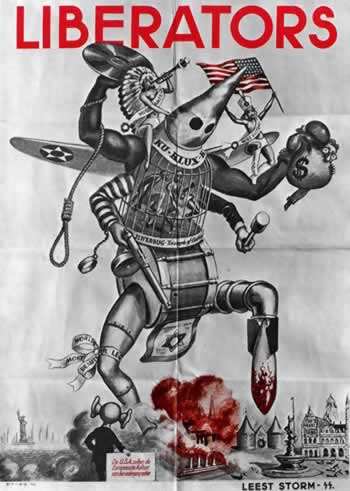 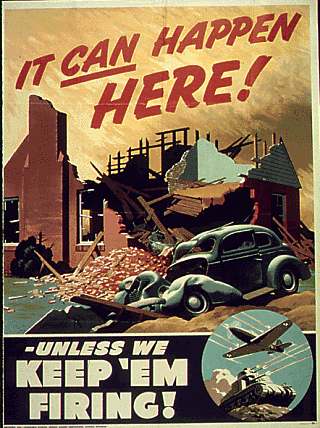 |
