BACK Technical Design
Due to its high standard technical functions the Cannon 450D single lens reflex (SLR) is the leading camera in the media industry. Some of these functions include a 12.2 Megapixel CMOS sensor, EOS Integrated Cleaning System, 3.0” LCD with Live View mode and a new 9-point AF system. This camera offers an unlimited amount of visual creativity. This is also the camera that I used for my own photojournalism. | 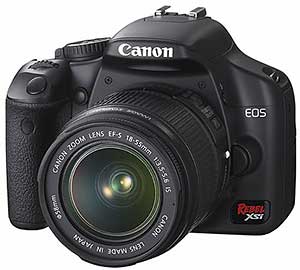 |
Depth of field: the depth of field varies depending on aperture, camera type, and focusing distance. This is because the depth of field is what determines how sharp or in focus part of the photo is. Depth of field is set through the use of the “F-stop number”. This means that the lower the F-number the more light is being let into the camera which in turn creates a shallow depth of field. On the other hand, the higher the F-number the less light is being let in so the deeper the depth of field. With the correct setting you can have a subject in the front of the photo in perfect focus and all of the back ground blurred or out of focus. Alternatively, you could have three subject and the first and last could be out of focus and the middle be in perfect focus. In other words, this setting allows you to control what you want to be shown in the image.
Shutter Speed: shutter speed is the amount of time that the shutter in the camera is open for. The way shutter speed is measured is in seconds; such as 1/60 or 1/200. The lower the second number the more blurry the image will turn out as the less amount of time the shutter is open for. If your aim is to capture a scenario in which a lot of movement is occurring and you want the image to look “frozen in place” than you would want to have the shutter speed above 1/150. An issue with low shutter speed is “camera shake”. This is when the shutter speed is so low that the camera picks up the natural shack of the photographer. This is why if the shutter speed is lower than 1/60 it is best to use a tripod to stabilize the image. However, photography is an art therefore there is no “correct” setting; it is up to the photographers creative aim.
|
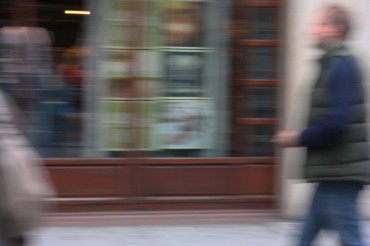
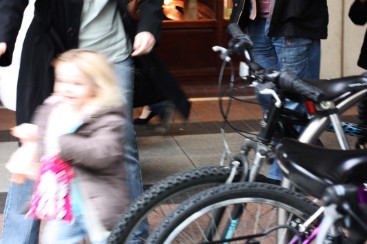
The photos above are examples of my experimentation with shutter speed. The shutter speed and depth of field settings on the camera were very useful in my own work. For example, when I was out shooting I put the camera on a low shutter speed of 1/60 to see what effect it has on the camera. Although, I choose not to use the photos the extremely blurry affect seen below was quite unique as it showed the rush of people shopping merge together and created a meaning for the photos. Although, I choose not to use the photos the extremely blurry affect seen below was quite unique as it showed the rush of people shopping merge together and created a meaning for the photos. Photo Editing I did 2 photo-essays and during the editing process for my first one “life around Portsmouth Harbour” I encounterd issues with opening the RAW files which led me to do the editing using Adobe Photoshop CS5. However, this experience gave me the opportunity to experiment with both Photoshop CS5 and RAW as my 2nd photo essay “Gunwarf Quays” was edited through RAW processing. Through this year we have been introduced to various technologies and software. In the photos above, I used Photoshop to edit them. To better enhance the portion of the photo that is in focus I increased the contrast in the photo on the right. This then shows the little girl in a blur and over-exposed while the bikes and people behind her are in focus and at a normal colour balance. This depicts how the little girl is full of energy and running around, whilst everything else is frozen in place. The photo on the left has nothing in focus, however in editing I decreased the brightness so the image was not over exposed and so that even though the image was taken with a low shutter-speed it was more clear what was actual in the photo. |
