Martin Parr
(b. 1952)
A British
documentary photojournalist and a full member of the Magnum Photographic
Corporation, Parr originally began his photography career taking photos in
black and white, as seen in his work Bad Weather (1982) and A Fair Day (1984)
before switching to shoot in colour. In his colour film work, his pictures are
vibrant and exciting, using an everyday approach to construct symbolic social
issues, shooting in a reflexive mode. He engages in the social issues, adding a
sense of realism to his photography, as well as acknowledging his audience.
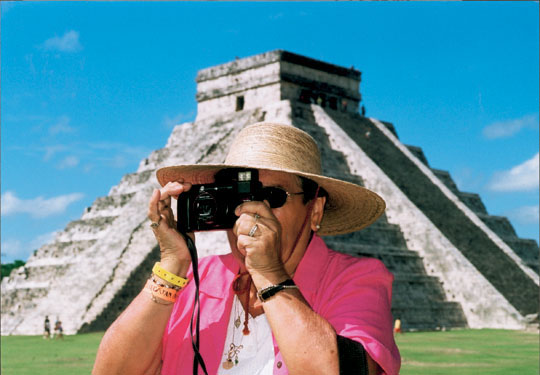
As you can
see in this particular photo it is vibrant, full of high saturation and strong
colours. Objects in the photograph, including the sky, grass and the woman’s
pink shirt have a robust vibrancy, almost jumping out of the photograph. The
colours are exaggerated and garish, and his reason for shooting and editing his
photography in this style is “propaganda.” The viewer sees Parr’s unique view
of the world, and how he envisions life.
Walker Evans
(1903 – 1975)
Walker Evans
was an American photographer, who was invited to join the federally sponsored Farm Security Administration, which
consisted of a small number of photographers employed to bring to light the
harsh conditions of the rural poor of America. His photos were styled in a
poetic mode, lyrically showing the dire and poverty stricken living conditions
of a warn- torn America and his photography during this period led him to
become an established photographer. Themes of his work consisted of hope,
belief and decline.
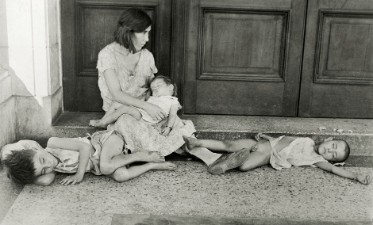
Evans’
pictures denotes poverty in it’s cruellest form; the mother and children
wearing rags as clothing, a depressive, worn expression on the mother’s face as
she looks on in the distance, almost ready to give up. The two older children
on the floor lay asleep, yet the child on the right looks as if he may have
died with his arm outstretched, his final plea of hope. The colouring of the photograph,
a light sepia tone, adds to the poor atmosphere, and gives off a mood of
nothingness. The picture is powerful, the subjects unaware of Evans, a part of
history frozen forever.
Dorethea
Lange (1895 – 1965)
Another
influential American photographer, Dorethea Lange was an expository
photojournalist, and too was hired by the FSA along with Walker Evans. She
raised many political and social issues with her photography, documenting The
Great Depression and exposed the true poverty that had stuck rural America.
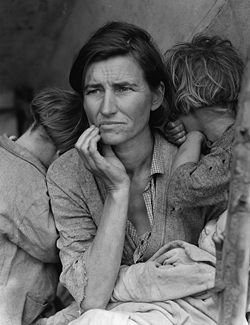
One of her
most famous pictures was Migrant Mother,
which was taken in her employment at rural America, and depicted a mother
living through the Great Depression, looking on gravely as her children hold
onto her. The emotion is drawn from the mother’s face, her worry etched into
her furrowed brow, her clothes ragged and torn. The bleak expression on the
mother’s face affects the viewer, who sympathise with her existence in such a
dire period. Lange’s skills to capture all this emotion in one picture are
exceptional, such powerful symbolism being drawn to the viewer. An image that
has been globalised and has become so infamous that it’s almost become the definition
of poverty.
Henri-Cartier Bresson (1908 - 2004)
“There is nothing in this world that does not have a decisive moment.” –
Henri- Catier Bresson.
Henri- Cartier Bresson is considered to be
the father of modern photojournalism, helping to develop the real life
reportage style that has influenced so many other photojournalists. He was in
favour of decisive moment, capturing real life in that one moment where history
could be immortalised. Bresson did not believe in staged photographs, instead
opting to shoot with no agendas or politics. He wanted to capture life as it’s
most natural, and he practiced this style of photography when he documented
Gandi’s funeral in India, 1948.
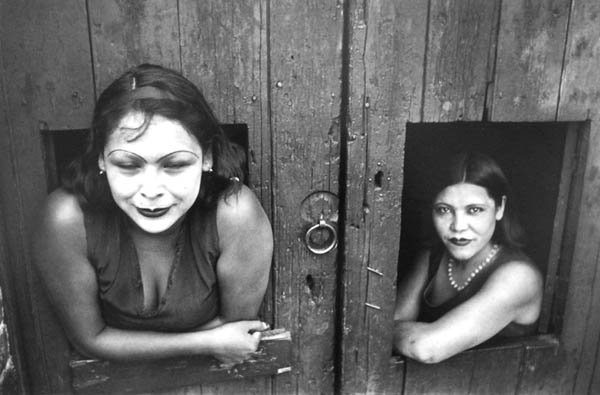
As you can see from the photograph, this is
Bresson’s work in motion. Using his stylistic technique of decisive moment, he
has photographed two prostitutes waiting in the windows of an oak door. The
woman to the left is unaware of Bresson, whilst the woman to the right has
spotted him, and in a second has captured the emotion behind her eyes. She’s
curious as to what Bresson is up to, almost trying to lure him with her eyes.
She seems meek compared to the woman to her left, who oozes sex appeal and a
confidence much stronger than the meek woman. The photograph bares the timid
woman’s soul; she’s trapped in a lifestyle, which she cannot break out of, that
of which she does not enjoy, and in that moment that Bresson had photographed
her, it seems as if her wall had broken. The image is powerful, engaging
emotion from the audience, who understand the pain she must feel. It was shot
to possibly raise awareness, for people of Great Britain to see how the other
half of the world live, the squalor and misery they live through, the poor
living conditions that they are entrapped within.