New Media Application
Advertising is key in promoting everything from documentaries to fragrances. It’s a powerful way of reaching out to a target audience for a particular product you want to promote. It’s a way to generate buzz to get people talking, as word-of-mouth can also be an effective way of promoting a documentary. There are so many media platforms to use as a way to advertise, such as Twitter, Facebook and television advertising. The more powerful the advertising, then the more viewers it will be likely to attract, thus generating a lot of money for the production companies behind the documentary itself.
BBC: The BBC produce and broadcast over 70 documentaries a year, and use media platforms such as social networking sites as a way to reach their target audience and draw in more people who will be interested to watch the documentary. BBC Three especially use sites such as Facebook as a way to promote their films, as it’s a free and easy to set up, and by sharing links on other people’s pages the promotion can spread like wildfire. BBC One and Two focus more on political issues, where as BBC Three, which is a channel aimed at teenagers especially, produce and broadcast documentaries that their young teenage audience can relate to; life in the tough London streets, serious medical illnesses that affect teenagers and how young people cope with disabilities, such as Small Teen, Big World. They offer a great insight into how young people cope and overcome their problems, as well a trying to get their audience involved by logging on their websites and finding out more information on the issues raised online.
Channel 4: The public service remit for Channel 4 is the provision of a broad range of high quality and diverse programming which, in particular: makes a significant contribution to meeting the need for the licensed public service channels to include programmes of an educational nature and other programmes of educative value. (http://www.channel4.com/info/corporate/about/channel-4s-remit) Channel 4 documentaries have a range of different modes and genres, from expository to performative and biographical to investigative. They produce a huge range of documentaries to fit their young adult viewing audience, from Dispatches to My Transsexual Summer. The documentary that I am going to explore is a Channel 4 seven-part documentary series; Educating Essex. It is an observational documentary series, shot in a expository mode, to uncover how a staff and pupils at a secondary school deal with the loom of GCSEs and the everyday issues that arise at a secondary level of education.
|   |

EDUCATING ESSEX
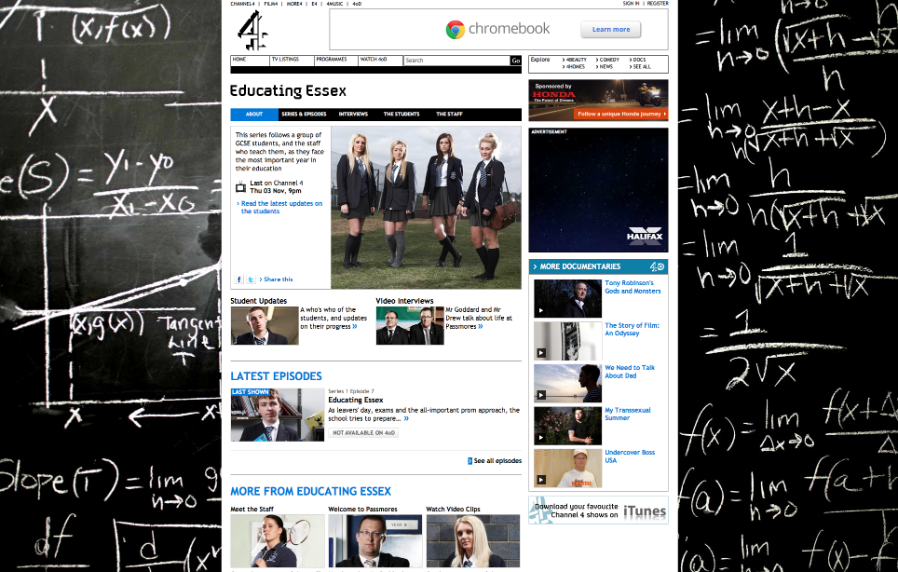
Educating Essex was heavily advertised and promoted amongst Channel 4 as well as on their other owned channels such as E4 and More4. The documentary-series pulled in 1.4m viewers on it’s broadcast of their first episode, and figures climbed slowly up throughout the series. The show was also popular on Channel 4’s catch-up service, 4OD, and it was also heavily promoted on the Channel 4 website, especially on their homepage as well as their 4OD page.
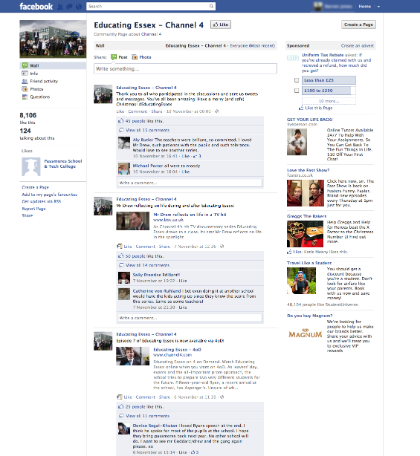
Facebook is a widely popular social networking site with over 3 billion users. Similar to the official website, a Facebook page can offer the same information such as the next broadcast dates and news updates for fans, appearing in their newsfeed further promoting their show. For a documentary series in its first season, Educating Essex have gained over 8,000 likes on their page. It’s a powerful media platform that can allow Educating Essex’s target audience to garner more news about the show and prompting stronger viewing figures.
|  |
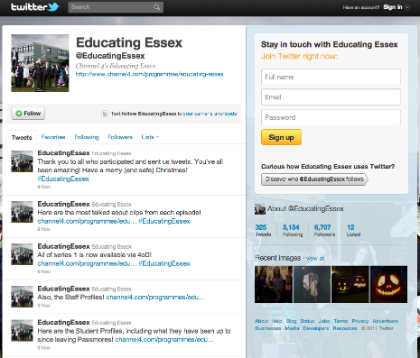 | Another social network site that lets the documentary advertise by appearing in a follower’s Twitter feed. A unique function with Twitter is that you can have trending topics, and if a user who does not follow Educating Essex looks at the trending topics and sees the show there, they can click on the link and see all the positive or negative posts about the documentary series, which again is another innovative and powerful way of further gaining more viewers. Educating Essex’s Twitter has an impressive 6,000 followers, and it’s increasing. Social networking sites such as Facebook and Twitter are a brilliant way of reaching out to more viewers as it gets fans of the show to speak and post about the show, promoting audience attraction and curiosity.
|
YouTube is another way to further promote and advertise your documentary or TV programme to reach a wider audience. The ability to comment on the video and either ‘’thumb up’ or ‘thumb down’ it provides feedback to the production company, who can read their statistics and see which country and what particular area the video has been well received in. Many productions companies and television companies are teaming up with YouTube as a way to advertise their programmes, and if popular enough, the videos can trend worldwide, attracting mass audience viewing figures. The internet is such a fast, effective and easy way to promote a piece of film, and to further advertise to gain wider audience figures. The Educating Essex trailer was well received on YouTube, gaining nearly 30,000 views as well as around 80% positive feedback. It was a useful way to appeal to a young audience who use video sharing sites and social networking sites a lot, so that they could send what they believe to be interesting programmes to their friends, and either post about it on their Facebook’s or tweet the link on their Twitter. |
