Documentary Processes
By Ainsley Brooks
Documentary is one of three basic creative modes in film, the other two being narrative fiction and experimental avant-garde. Narrative fiction we know as the feature-length movies we see in theaters or on TV or DVD; they grow out of literacy and theatrical traditions. Experimental or avant-garde films are usually shorts shown in nontheatrical film societies or series on campuses, in art museums, or available in a few video anthologies; usually they are the work of individual filmmakers and grow out of the traditions of the visual arts.
Practitioners Michael Moore was born in Flint, Michigan April 23, 1954. His first film - Roger & Me (1989) was so successful he became one of America's best-known and most controversial documentarians. He has produced a string of documentary films and TV series predominantly about the same subject: attacks on corrupt politicians and greedy business corporations. He landed his first big hit with Bowling for Columbine (2002) about the bad points of the right to bear arms in America, which earned him an Oscar and a big reputation. He then shook the world with his even bigger hit Fahrenheit 9/11 (2004), making fun of President George W. Bush. This is the highest-grossing documentary of all time. | 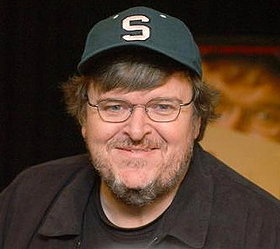 Image: http://www.rottentomatoes.com/celebrity/1055159-michael_moore/ |
Michael is known for having the guts to give his opinion in public, which not many people are courageous enough to do, and for that is respected by many. A look at Bowling for Columbine, in producing his Oscar-winner, Moore altered history, misled his viewers, and edited the footage and audio in such a way as to reverse the meaning. In one case, he took a speech of a person he desired to target; the problem was that the speech was in fact conciliatory and mild. So he spliced in footage from another speech, cut out paragraphs, and spliced the beginning of one sentence to the ending of another. In another, when he wanted to criticize a political advertisement, but it wasn't as pointed as he wanted, he spliced together two different political ads, and then added titling, which was in neither. Source: http://www.mooreexposed.com/
Fahrenheit 9/11 is another well known documentary by Moore, the BBC said Disney even refused to release this film, other distributors also seem reluctant and - if Moore is to be believed - the White House wants to stop it being seen. The reason is if viewers take the film at face value, they will think George Bush is a fraudulent and possibly corrupt president who went to war in Iraq because of a half-baked motivation of grudge, greed and thirst for power.
But this is a Michael Moore film and, while that does not mean he is wrong, it must be watched with a critical eye. Moore wants Bush removed from office. He is determined to have this film released before the US presidential election in November for that very reason. The film's conclusions are reached through a mixture of firm evidence, interesting information, moving scenes and tenuous theories. Starting with the presidential election in 2000, it firmly plants the idea that Bush's election - thanks to just 537 votes in Florida - was not exactly free and fair.
The first conspiratorial link comes when he identifies the Fox News Channel employee who took the decision to report that Bush had won Florida on election night - when all other channels were reporting an Al Gore win - as Bush's first cousin. If true, it is an interesting piece of trivia - but hardly proof of a family plot to steal the presidency. He introduces 11 September with a blank screen and chilling audio of planes hitting the Twin Towers and the cries of those on the ground. Moore also has footage of Bush sitting in a school classroom, reading a children's book with pupils, for more than 10 minutes after being told the second plane had hit. The film-maker said this full footage had not been seen before because no-one had asked the teachers at the school whether they had captured it on camcorder. One of Moore's chief accusations is Bush allowed planes to pick up 24 members of the Bin Laden family and fly them out of the US in the days following the attacks - when all other aircraft were grounded. To back this up, he shows a document that seems to list them - and uses it as a base from which to explore the relationships between the Bush and Bin Laden dynasties.
Sicko (2007) The film investigates health care in the United States, focusing on its health insurance and the pharmaceutical industry. The movie compares the for-profit, non-universal U.S. system with the non-profit universal health care systems of Canada, the United Kingdom, France and Cuba. Thisfilm demonstrates how one mode can combine with other modes especially in the use of interviews. The guiding role of the direct address commentary in Sicko (expository mode) and the dialogue is quite central. |
John Pilger John Pilger was born in Sydney, Australia October 9, 1939. "The Quiet Mutiny" in 1970 was the first of over 60 documentary films by Pilger. Filmed at Camp Snuffy, the film presented a character study of the common US soldier during the Vietnam War, revealing the shifting morale and open rebellion of Western troops. Pilger described the film as "something of a scoop" - it was the first documentary to show the open rebellion within the drafted ranks of the US military that led to the withdrawal of the land army in 1973. According to Michael Chanan from “The Politics of Documentary” he argues that practitioners of a direct mode of address which on a frander scale has come to dominate television documentary to the present day, the illustrated discourse delivered by its author – reporter or intellectual expect, John Pilger- in ever changing locations, partly to camera and partly voiceover,manoeuvred by a director whose essential function is the technical one of devising the visual treatment". (p173, The Politics of Documentary) | 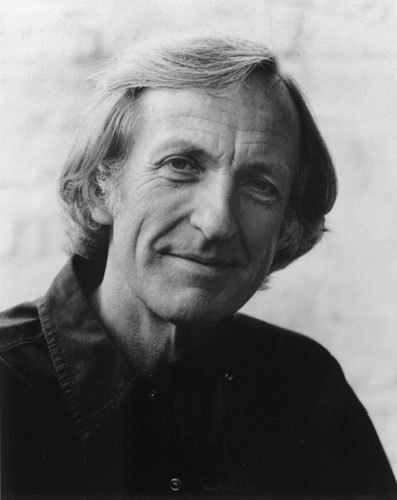 Image: http://www.socialistunity.com/?cat=332 |
John Pilger is not only a documentary film-maker but also a journalist, he has said “It is not enough for journalists to see themselves as mere messengers without understanding the hidden agendas of the message and the myths that surround it” and “Official truths are often powerful illusions”.
Stealing A Nation reveals the extraordinary story of the secret expulsion of the entire population of the Chagos islands in the Indian Ocean by successive British governments, so that the principal island, Diego Garcia, could be handed to the United States as a major military base. It is from this base that American aircraft have attacked Iraq and Afghanistan.
"This is a shocking, almost incredible story. A government calling itself civilized tricked and expelled its most vulnerable citizens so that it could give their homeland to a foreign power...ministers and their officials then mounted a campaign of deception all the way up to the prime minister." - John Pilger
Nick Broomfield (Born 1948) is an English documentary filmmaker. Broomfield works with a minimal crew, recording sound himself, usually holding the sound boom and wearing the Nagra tape recorder. Biggie and Tupac is a popular documentary made by Nick Broomfield, it is an investigation of the deaths of the two icons. In this, you see how Broomfield works with the camera and how he works with the people in front of the camera. Broomfield chases to the point he wants and rather than letting them answer the question, he basically answers it for them to get the response he wants. Broomfield is performing for the camera and manipulating the primary. Biggie and Tupac is a good example which shows Broomfield doing this. |
Documentaries
The Cove (2009) directed by Louie Psihoyos is about a group of activists, led by renowned dolphin trainer Ric O'Barry, infiltrate a cove near Taijii, Japan to expose both a shocking instance of animal abuse and a serious threat to human health.
The camera crew set up secret
cameras and filmed them 24/7 until they had enough footage, when the film was
released it caused outrage. |
Article (gearlog.com and Guardian)
The Cove shocked the world when it hit theatres in 2009, with its graphic depiction of Dolphin slaughter in Taiji, Wakayama Prefecture, Japan. The film debuted in Japan last year, with the faces of Taiji fisherman edited out for anonymity. According to Japan Times, a number of theatres in the country cancelled screening of the film after receiving threats from right wing groups.
An anonymous environmental group called People Concerned for the Ocean is working to further spread The Cove gospel, delivering dubbed Japanese copies of the movie to every home in the small town of Taiji.
The film's director, Louie Psihoyos, supports the cause, telling the press, "The people in Taiji deserve to know what millions of others around the world have learned about their town by seeing The Cove.”
This outstanding documentary is as exciting as a thriller and centre’s on a character as fascinating as William Wilberforce's mentor, Captain John Newton, the skipper of a slave ship who took holy orders, wrote "Amazing Grace" and became a fervent abolitionist. In the 1960s, the handsome, charismatic Richard O'Barry trained the performing dolphins used in the popular, long-running American television series Flipper, which resulted in the creation of “dolphinariums” the world over.
From director Davis Guggenheim, An Inconvenient Truth is a passionate and inspirational look at former Vice President Al Gore's fervent crusade to halt global warming's deadly progress by exposing the myths and misconceptions that surround it. In this intimate portrait of Gore and his "travelling global warming show," Gore comes across as never before in the media - funny, engaging, open and intent on alerting citizens to this "planetary emergency" before it's too late. Interspersed with the bracing facts and future predictions is the story of Gore's personal journey: from an idealistic college student who first saw a massive environmental crisis looming; to a young Senator facing a harrowing family tragedy that altered his perspective; to the man who almost became President but instead returned to the most important cause of his life. With an emphasis on hope, An Inconvenient Truth ultimately shows us that global warming is no longer a political issue but rather, the biggest moral challenge facing our civilisation today. |
Documentary styles
Definitions of the different modes:
Docufictions - Docufiction or docu-fiction often confused with docudrama is a neologism which refers to the cinematographic combination of fiction and Documentary film Concerning a film genre in expansion. (www.documentaries.about.com)
Ethnofiction - Ethnofiction is a neologism which mainly refers to docufiction, a blend of documentary and fiction film. It’s used in visual anthropology as ethnography. Its object is not the individual but the ethnicity, excepting when the individual represents it. (Google Definition)
Docudrama - A dramatized television movie based on real events usually found in the case of American and British propaganda films from world war two. Uses invented sequences of events, and fictional protagonists, in order to illustrate the salient features of actual occurrences or situations. (Docufiction book)
Mockumentary – Mock-documentary is entirely fictional yet, unlike most docudrama, appropriates the look of documentary much more closely. (Docufiction book)
Observation Mode - Emphasizing the documentary filmmaker's engagement in observing the subject's daily life and circumstances and documenting them with an unobtrusive camera. (www.documentaries.about.com)
Poetic Mode - 'reassembling fragments of the world', a transformation of historical material into a more abstract, lyrical form, usually associated with 1920s and modernist ideas (www.mediaknowall.com)
Expository Mode - 'direct address', social issues assembled into an argumentative frame, mediated by a voice-of-God narration, associated with 1920s-1930s, and some of the rhetoric and polemic surrounding World War Two. (www.mediaknowall.com)
More information on Documentary modes:
http://documentaries.about.com/od/terminology/g/expository.htm
Cinema Venite and Realism
Cinema Venite is a style of filmmaking; it combines naturalistic techniques that originated in documentary filmmaking.
Honesty or not?
It was self references – what you’re watching is a tool. The aim of some documentaries is to focus on the audience so they can relate to it, more so working class. We see something we will not always get to see – the audience gets involved in the project.
Documentaries that changed the world: John Pilger -> he is the primary, he leads the subject to the answer.
War: Showed the real them, the influence is embed. Pilger was anti-war and showed this in his documentary, this was his agenda.
• Styles: Journalistic, entertainment, semi-anthropological – the different styles used for documentaries.
• Special effects are sometimes used in documentaries – fade, dissolve, etc.
• Styles: Music, editing, camera movements, narrations and so on...
• Types: Documentary, Ethnographic film, cinema doc film (ie. Man bites dog and the Blair witch).
Cinema Verite Cinema Verite, literally film truth, was a style of film making developed by French film directors in the 1960’s. Their production techniques did not depend on star quality actors, sets, props, casts of thousands, special effects and big budgets which was the trend in Hollywood films then as now. The cinema verite directors used non-actors, small hand- held cameras, and actual homes and surroundings as their location for a film. One of their production techniques was to tape record actual conversations, interviews and statements of opinion make by real people. Then they would find pictures to illustrate the actual sound recordings. The final production was put together in the editing room (which is also true of fiction/fantasy films). Cinema verite was characterized by the use of real people (not actors) in unrehearsed situations. Filming was done with unobtrusive cameras so the subjects of the film would forget the presence of the camera and just be themselves. The filmmaker’s goal was to show life as it really is using the film as his artistic medium. Sets and props were never used and everything was shot on location, often with a small, portable camera. The camera could be taken into people’s homes, automobiles, and other places where the heavy, bulky feature film cameras could not easily go.
"Some famous French examples of cinema verite are “Chronicle of a Summer” (1961) by Jean Rouch and “Le Joli Mai” (1962) by Chris Marker. A famous French film director who was influenced by cinema verite was Jean-Luc Godard. His first feature film “Breathless” (1960) was shot without a script. He improvised the film as he went along, sometimes writing dialogue and rehearsing actors on the spot just before he would “roll cameras for a take."
Taken from: http://www.parlez-vous.com/misc/realism.htm
Forms of Documentary Voice
Direct Address - usually the voice of authority, do not see the speaker - voice of god (voice over commentary)
Indirect Address - Conveyed by social actors, conveyed by film technique. The filmmaker tells us things by means of editing, composition, camera angle, music, effects, etc. It is up to us to interpret how these choices address us.
Camera work and techniques
4th Wall The fourth wall in film, television, and video games is defined as the screen in front of you — that line of demarcation between you and the story. Originating in the days of the stage, breaking the fourth wall meant that someone onstage was stepping out of their fictional universe to talk directly to or acknowledge the audience
The camera has a big impact on the viewer, the shot and the way it is framed usually produces different emotions. For example, a close up on someone crying will make you feel more emotion for them over the same shot but being shown in long distance shot. | 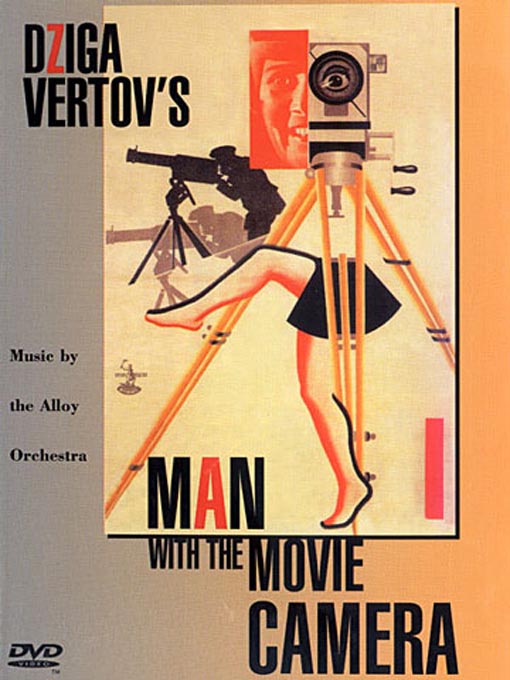 Image: http://timbmartens.com/ebertfest-2010-man-with-a-movie-camera/ |
