PROFESSIONAL PRACTICE
Ethical Issues within Documentary
Ethical issues include twisting the truth: This has created a lot of controversy for several documentaries including: Mighty Times: The childrens March. - Did this misrepresent civil rights history through use of both fabricated and repurposed archival evidence?
It began in 1935, and freely combined actuality footage with dramatised sequences in a style that Henry Luce, head of time, called “fakery in allegiance to the truth”
Should films such as Ghosts of Abu Ghraib feature images that further embarrass and humiliate their subjects?
(Sourced from: Truth or Dare: Theoretical and Ethical considerations) LINK
‘Budgets demand efficiencies that may be ethically troubling.’ for instance, a filmmaker was on location shooting a wildlife film, trying to capture one animal hunting another.
“We tried to shoot a few, and missed both of them. Unbeknownst to me, the [animal wrangler] broke the next rabbit’s leg, so it couldn’t run. So we got one. On the next take, they then asked, “Should we break its leg again?” . . . the DP [director of photography] was sitting there, saying “No, I’m sure you wouldn’t want to do it,” but nodding his head yes. I made the decision, let them break it. I regret it. It eats me up every day. I can sort of rationalise this, that it might be killed by a natural predator. But for us to inflict pain to get a better shot was the wrong thing to do.”(Sourced from: Centre for Social Media) - LINK
The debate around documentary film's moral obligation to be objective, or at least fair, has been rekindled by the recent and commercially successful films of Michael Moore.
His first film, Roger & Me (1989), ‘the most commercially successful documentary to date, established Moore's trademark approach, a combination of an unabashedly personal tone, his own provocative verité presence, and a strong sense of humor.’
He has been attacked for manipulating the truth and ‘violating ethical proprieties. For example, in Bowling for Columbine (2002) he ambushes the actor Charlton Heston, then president of the National Rifle Association, questioning him about his culpability in the accidental death of a child by gunfire.(Sourced from: Truth or Dare: Theoretical and Ethical considerations) LINK
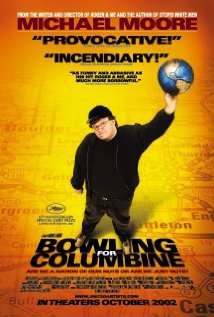
Image sourced from: http://www.imdb.com/title/tt0310793/
Awareness of Styles and Concepts
Film makers are fully aware that their choice of angles, shots and characters were personal and subjective, and this is manipulation within filming, as by cutting or focussing on one aspect in a scene could completely change the meaning of it as the truth could be hidden or twisted.
Staging, Re-staging and Effects
‘Many filmmakers noted that restaging routine or trivial events such as walking through a door was part and parcel of the filmmaking process and was “not what makes the story honest.” But many filmmakers went much further, without discomfort.’
For example, film makers regularly used re-creations of events, although they widely believed it was important that the audience be made aware somehow that the footage is re-created.
(Sourced from: Centre for Social Media) - LINKIndustry codes of practice: OFCOM
Ofcom (the Office of Communications) regulates the content of all television and radio programmes in the UK, including programmes on the BBC and all digital channels, as well as Channel 4, Five and ITV. Ofcom operates the Ofcom Broadcasting Code (“the Code”) which contains rules and principles covering standards in programmes, sponsorship and fairness and privacy. Here is the LINK for OFCOM rules.
When filming our documentary, we would like to incorporate techniques like the use of angles and shots in order to represent what is happening within a particular scene. For example, we want to film reactions (physical expressions) as well vocal reactions and possibly juxtapose them. i.e someone might have a particular view that they talk about towards greyhounds, whereas their physical reactions might be a sign of being uncomfortable.
We would keep to some of OFCOMs codes, such as not humiliating the people we film and we would also like to demonstrate the truth rather than manipulate it too much through the use of the observational mode.
An interesting idea would be to break the 4th wall and possibly have someone to speak to the camera or ask the audience a question. This could be done through narration (voice of God).
