Critical Reading
Documentary in an Era of Digital Convergence
Sharon Lin Tay
This article explains how documentary has changed in the digital era. It goes on to say that digital convergence disrupts the linear structures that are conventionally ascribed to documentary.
Its described as re-thinking Documentary and the accuracy of representation. The emergence of new media is said to have ‘loosened the index-ical relationship between the signifier and signified.’ This has resulted in doubts about the accuracy of representation to its ‘referent’ that digital media casts. This has significant implications for documentary practice in the digital age.
The documentary film has had a ‘rich and complex historical trajectory’ that has effectively given rise to its particular rhetoric and theoretical orientation.
-The post war rise of Italian ‘neo-realism’ that strives towards the truth in the uncontrolled event
-The technological innovations of the 1950’s that provided the film-makers with the portable equipment with which to make documentaries that appear to further eliminate artifice
-The rise of various film movements such as Direct Cinema in the US and Canada, Free Cinema in Britain and Cinema Verite in France.
These factors all contribute to the alignment of the documentary film with ideas of realism and truth.
Tay, S. L. (2008), ʻUndisclosed Recipients: documentary in an era of digital convergenceʼ, Studies in Documentary Film 2: 1, pp. 79–98
Database Documentaries and the Internet
Dale Hudson
David Hogarth (2006: 127–29) argues that ‘interactive technologies could extend and deepen modes of engagement’ and that ‘digital documentaries promise to make sense of the world in less restrictive ways’, such as online productions that ‘may allow new forms of dialogue with documentary form, undermining authoritative (and authoritarian) modes of communication along the way’.
I agree with Hogwarth as documentary has become very interactive.
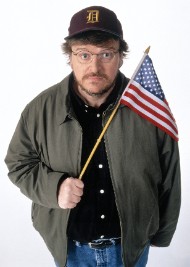
The use of a the expository mode (voice of god) often asks the audience questions. This makes them less passive and forces them to react to the 'reality' that has been put in front of them and to think about what they believe. I think documentary audiences engage more often with documentaries, as many documentary film makers take the form of a ‘friend’ or someone to speak their questions. This is the participatory mode, which helps audiences to build their trust in the film make and go with him/her on their journey. This can be seen by documentaries from Michael Moore.
Grierson and the British Documentary Movement
John Grierson was ‘heavily influenced by ideas about the educative possibilities of documentary and he argued strongly for support of both production and distribution of films for the education of audiences as a contribution to the development of an informed citizenry.’
Industrial Britain (1931), Song of Ceylon (1934) and Housing Problems (1935) introduced the idea of documentary as an educational tool. They in turn, helped practitioners to develop their filming skills and experiment with film form. The 1930’s were seen to be Britain’s contribution to ‘world cinema’ and the development of cinema as an art form.
Below is an extract of an interesting article I found online about war time documentaries. Click Here For Article:
‘The films aimed at British audiences weren't only shown in cinemas, but also in factories and social clubs. Local audiences were addressed with increasing frequency, says Faul. "Cinemas would have films of local councillors appealing for people to look after, say, single female neighbours, or to dig allotments. We've got one called Greenford and Northolt Dig for Victory (a 1942 film about Ealing Borough Council's allotment scheme for the Dig For Victory campaign), introduced by a local councillor. People embraced it locally after seeing what went on nationally."
FURTHER READING
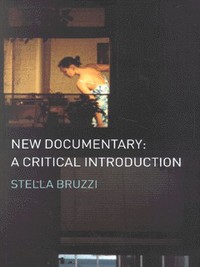
Stella Bruzzi (2000) New Documentary: A Critical Introduction, London: Routledge
This book addresses contemporary non-fiction output in the 1980s and 1990s. It challenges some of the prevailing statement of documentary critique and appraisal. Her analysis draws on theories of performance, performativity, authorship, gender, spectatorship and self-reflexivity. She disagrees with how Nichols suggested that documentary developed in a ‘rigid line.’ This suggests that these modes ‘interact’ and ‘overlap’ meaning that there isn’t really a boundary between them which was suggested by Nichols early on. I believe this is correct, as for the most part of the documentaries I have seen, they dont just stick to one mode. They mix it up to actively engage the audience into thinking how the documentary film maker wants them to think through their own representation of reality. Bruzzi stresses the development of a dialectical between the relationship between more innovative non fiction films and the ‘established documentary canon.’The evolution has been determined by the ‘endless quest of documentary film makers for better and more authentic ways to represent reality.’ Exposed Wounds:The Photographic Autopathographies of Hannah Wilke and Jo Spence Click Here for article. Viewers are typically torn between embracing or refusing empathy towards an image and towards the subject depicted. This article I found shows the 'potent ties between illness and artistic representation.' These ties reach back at least as far as the 'Ancient Past' notably in the guise of objects invested with restorative powers, such as amulets and talismans. Autopathographic works raise significant ethical questions that pertain to viewers’ responses and responsibilities in the face of images of suffering. The images on this article are direct forms of documentary that show the brutality of cancer and AIDS. They engage the audience towards an empathy, even when the subjects are doing a 'heroic' pose. Charles Forceville THE SOURCE–PATH–GOAL SCHEMA IN THE AUTOBIOGRAPHICAL JOURNEY DOCUMENTARY McElwee, van der Keuken, Cole
The source–path–goal schema is one of the most fundamental schemas governing human conceptualizing with regard to sense-making (Johnson 1993; Turner 1996) This reading, talks about journey and quests and how sometimes, a record of that journey-cum-quest is made. A record in the form of a novel, a comic, a film, a blog. 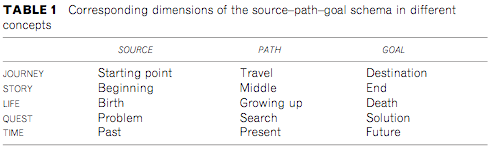 Sherman’s March (Ross McElwee, USA, 1986) The film is the story of the journey and of this double-edged ‘quest’. McElwee reinforces the similarity between himself and Sherman—and their respective quests—in various ways. He muses, for instance, ‘I keep thinking that perhaps I should return to my original plan to make a film about Sherman’s march, but I can’t seem to stop filming Pat’ This clip gives the audience a look into another life through the use of the expository mode. Filming a journey builds a bond between the film maker, his subjects and the audience. They empathise with the reality they are being shown and want that person- for example Pat, to succeed in her quest to become an actress. Journey level: There are two parallel journeys.1 The first journey traces historic sites connected to General Sherman; the second traces 'women from the south' and portrays McElwee's meetings with them . Quest level: The quest is the search for the possibility of romantic love. Also the quest of the women he meets. for example this clip of meeting ‘pat’ begins to document her journey to become an actress. These clips include her journey in the car and to tell her parents shes leaving. Story level: The film itself constitutes the story level. The presence of the story level, however, is not just an automatic consequence of McElwee filming the journey and quest. Viewers are constantly reminded that they are watching a mediated representation. For example an element that stresses the self- consciousness of the film is that people comment on being filmed.
|  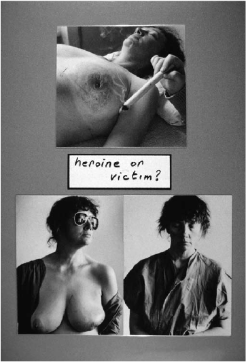 Jo Spence / Terry Dennett, Heroine or Victim? 1984, from The Picture of Health? 1982–86. Photograph, 70 x 50 cm (© The Jo Spence Memorial Archive  |
