Influential photojournalists; Robert Capa:
Mode: Desisive moment/Modern staged manipulator.
Robert Capa born in 1913 and died in 1954 was one of the most influential war photographers of all time.He is known to be the founder of Magnum photos and set standards for conflict photos for today.A main reason for this, is as seen in his photo he captured only decisive moments gaining only frontline images of a time of conflict.However this love for photos became a reason for his death as he was killed during battle in the 1950's.
This photo that was taken in the spanish civil war in 1936 really creates a breaking edge as it interacts with the audience to keep the image moving but also makes the audience create their own ending.It could be also argued however that the image also uses shuttering to show the pain of the solider giving emotion to the audience as it stops the event mid way. Another way in which Capa uses this image to his advantage is that the solider is also the mid focal point with a non-cluttered background focusing the audience only on the solider of the spanish war.Not only does this force the audience to focus on the solider but it also creates the shock factor for the image.Although their is speculation for this image to be a stage ontology it has never been proven,(independant,2009).
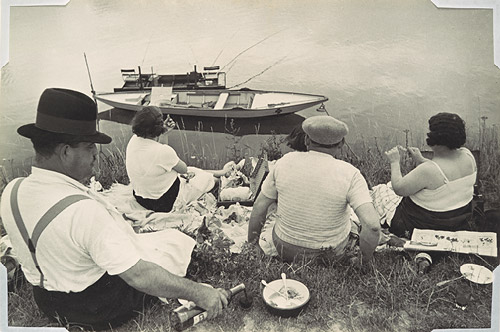
Henri-Cartier-Bresson: Mode: Decisive moment. Henri-Cartier-Bresson was an artist up untill the 1940s where he then found the use of the camera to express his feelings.He is known as one of the most influential photojoutrnalists of all time as he was the creter of the desisive moment.He stated that it was not the quick snap of a shutter but in fact it was the reality that he captured simultaneous recognition...of the significance of the event as well as a precise organisation of forms which give that event its proper expression.(Hayward,K......)The use of the term"proper expression" clearly identifies that Henri-Cartier-Bresson uses images to capture the reality of the event.He has a major influence on many photojournalists today an example being within the celebrity paparazzi method of capturing without knowledge of the focal point. On the right hand side of the screen one example of Henri-Cartier-Bressons work is the "Sunday on the Banks of the Marne" (1938) in which it is a simplistic image of two couples have a picnic at the side of the banks of the Marne.He uses a cluttered effect for this image which narrates the story to the audience.He takes the image from a high angled shot creating the image to have depth and emotion bringing the focus on the couples which are overlooking the banks of Marne.Using this he also uses depths of fields to show reality of the focal points.
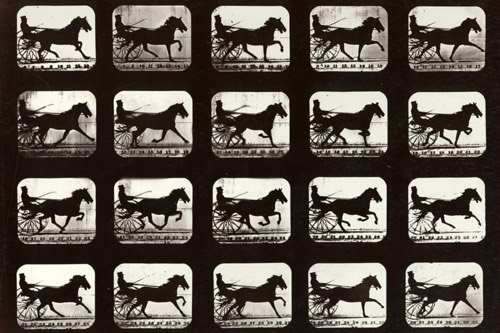
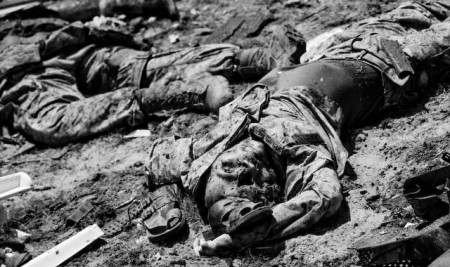
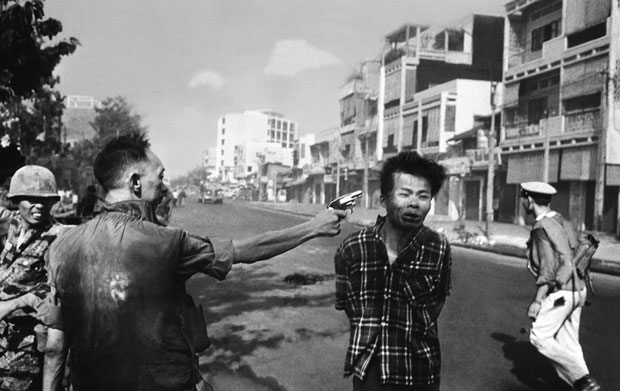
Eadweard Muybridge Mode: Modern staged manipulator Eadweard Muybridge (1830-1904) was known as the ‘grandfather of motion’ (Modrak, Anthes, 2011) due to his most influential images on motion of animals and humans. The most famous images that Muybridge produced was, the horse in motion (1882) in which he proved that there was an encounter of a brief moment, in which the horse within its gallop had all four hooves of the ground. Although technology was very limited without the technique of the modern ‘Burst’ Muybridge succeed in obtaining the same affects with a trip wire and numerous amounts of cameras. His technique was to align each camera in the same specific distances away from each other calculated to when tripped to gain each singular motion in a freeze frame. He used each freeze frame to identify each particular movement and to create a seamless motion picture. To gain the effect he had to use miminal background to show the focus on the legs.This use of images alone has influenced work such as the invention of the motion picture camera by Thomas Edison and the works of the famous painter Francis Bacon. Zoriah Miller Mode: Decisive moment Unlike the above Zoriah Miller is a modern 21st century photojournalist being well known for his war time photographs.He has travelled over 70 countries and lived within over 30 this alone is an achievement and highlights how passionate he is for photography. Although he is known for his war photography he is also known for his controversial and decisive moments as shown within the 2008 bombing within iraq.In which he captured the images of the aftermath of a bombing in which20 people were killed including three marines.The capturing of these images caused controversy with the us Government and forced them to be disembeded. The link below is a full article of this specific controversial disagreement: www.thinkprogress.org/security/2008/07/07/25826/zoriah-miller/The image that was so controversial it was forced to be removed captured reality greatly.As not only did Zoriah Miller capture a decisive moment which is shown through the cluttered background he used a depth of filed to highlight the focal point of the dead soldiers face.Which creates not only emotions for the audience but also creates a shock factor. Eddie Adams Mode: Decisive moment Eddie Adams born in 1933 and died 2004 is an influential war photojournalist,who has received over 500 awards for his work.He has been privileged enough to have his work published in major publications around the world these being; Vogue,Times,Vanity Fair and Parade. The most famous influential images that Adams produced was The Saigon Execution (1968) in which it is a photograph of an execution within the hands of Vietnam's police chief, Lt. Colonel Nguyen Ngoc Loan, at noon on Feb. 1, 1968 .This photo alone shows the fear,bravery and horror of war.He shoots at a decisive moment capturing not only the realistic cluttered background with the focal point of the victim being central.This add emotions to the audience but also eggsagerates reality of the fear within his face. |
 http://www.magnumphotos.com/C.aspx?VP=XSpecific_MAG.PhotographerDetail_VPage&l1=0&pid=2K7O3R1 4YQNW&nm=Robert%20Cap
 http://www.metmuseum.org/toah/works-of-art/2002.614.1
 http://iconicphotos.wordpress.com/2009/04/22/the-execution-of-a-vietcong-guerilla/ |
